Luxury doesn’t feel. It weighs.
It sounds like a slogan, but it’s more literal than it seems: in the method I’m about to walk you through, luxury genuinely has a weight, eight of them, in fact, one for each variable that composes it. Why does a Patek Philippe cost more than a hundred times a Casio G-Shock, despite being less accurate? The usual answer, the brand, the craftsmanship, the dream, isn’t wrong. It’s just too vague to help anyone who actually has to make a decision.
The problem: “luxury” doesn’t mean anything anymore
Ask ten managers in the industry what luxury means, and you’ll get ten different, often incompatible, answers. Mass luxury, affordable luxury, masstige: every new label stretches the perimeter of who gets to use the word, and every stretch empties it a little more. Meanwhile, real decisions get made, a line’s price point, a new distribution channel, a licensing deal, on grounds that collapse under one uncomfortable question: compared to what?
It isn’t a shortage of theory. The literature on luxury is rich: Veblen on conspicuous consumption, Kapferer and Bastien on the rules luxury deliberately breaks, Vigneron and Johnson’s psychometric indices. What’s missing is a tool built to be applied to an actual case and produce a number two people can argue about, instead of two opinions that just collide.
Anchor, Grid, Gradient. Three moves.
AGG isn’t a clever acronym: it’s a three-phase protocol, each phase built to answer a question the previous one leaves open.
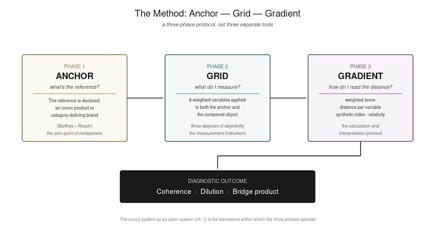
Anchor. What’s the reference point?
No judgment holds without a declared point of reference. The anchor is the product or brand chosen explicitly as the term of comparison: the Birkin for Hermès, the Daytona for Rolex, the Maltese cross for Vacheron Constantin. It isn’t an objective fact. It’s a choice that’s declared and defended, the way any serious discipline declares and defends a benchmark.
Grid. What am I measuring?
Here’s where the weight comes back in. Eight variables, each with an assigned weight, applied to both the anchor and the object under evaluation: extreme quality, creativity, high price (a consequence, not a cause), scarcity, conspicuousness, extended self, aesthetic appeal, time and rituals. Not an improvised checklist: a synthesis of what the literature has always treated separately.
Gradient. How heavy is the distance?
With the scores in hand, the Gradient calculates four things: an overall weighted score, the least useful of the four but the first thing you see; the distance per variable, where the real diagnosis hides; a synthetic dilution index, trackable over time; and a warning, none of these numbers mean anything in absolute terms, only relative to the declared weights.
A case, in two lines
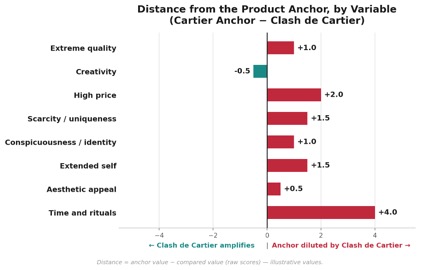
Anchor: Cartier’s Love and Panthère, aristocratic legitimacy and goldsmith mastery.
Comparison: Clash de Cartier, the younger line launched in 2019.
The verdict isn’t “it’s diluting”. It’s more precise, and more useful: on creativity, Clash de Cartier actually beats the anchor, a distinctive signature of its own. On time and rituals, the slowest variable to rebuild, the gap is stark. That’s where the real diagnosis lives, not in the total score.
It doesn’t work on everything. And that’s the point
The AGG Method doesn’t weigh just any product. Its eight variables encode the value logic of positional goods, the ones whose worth depends on managed scarcity, not that of mass-market goods, where scarcity is a problem to solve, not a lever to cultivate. That’s a declared limit, not a failure: a tool built to work on everything would have had to become too generic to say anything at all.
What it doesn’t do
It doesn’t teach you how to create. The gesture that produces a collection remains a personal act, culture, sensibility, intuition, that no grid can replace. The method works on the other half of the problem: giving whoever has to defend a brand’s symbolic value, in a room with an investor or a board, a shared language that can be argued with, instead of simply taken on faith.
The AGG Method is one of the original frameworks developed in Il Lusso Tradito, my forthcoming book on managing contemporary luxury. Working in the industry? Let’s compare notes in the comments.


Leave a Reply