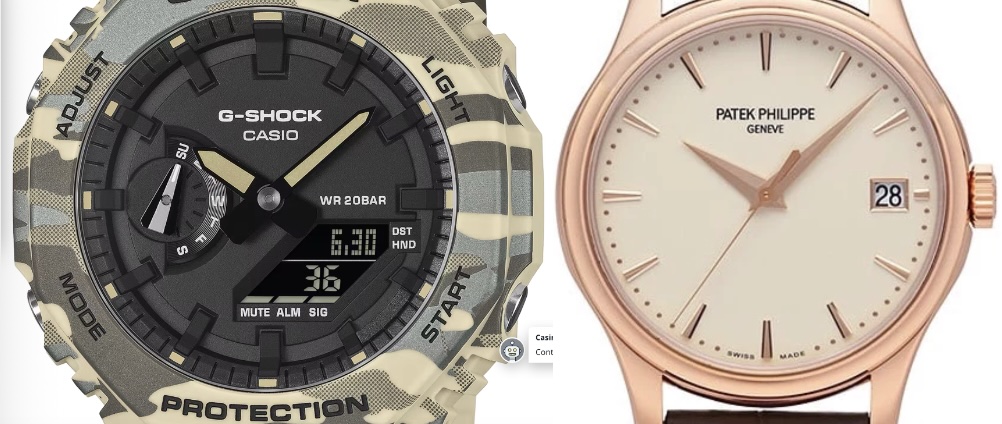
Picture having to choose between two watches. The first is a Casio G-Shock: accurate to the hundredth of a second, water-resistant to 200 meters, practically indestructible. The second is a Patek Philippe Calatrava: mechanical, capable of drifting by up to thirty seconds a month, fragile, needing protection from water and impact. And yet the second costs two hundred and fifty times more.
Try to explain that gap using the word “luxury,” and you'll quickly discover how unreliable the word has become. That's the first thing that pushed me, over the past several years, to write a book, and it's also where this series of articles begins.
A Twenty-Year Inflation
Over the past two decades, the word luxury has been bent to legitimize almost anything. Categories like mass luxury, affordable luxury, masstige, one more label promising to combine the exclusivity of luxury with the accessibility of the mass market, have proliferated. Premium disguised itself as luxury. Every new label stretches the perimeter of what can claim that word, and every unjustified stretch empties it a little further.
It isn't only a linguistic phenomenon. It has a precise counterpart in the product itself: goods that are fundamentally unremarkable, often copied from or inspired by famous brand icons, lacking any genuine creativity, whose chance of success rests essentially on price, get presented, and sometimes perceived by some buyers, as luxury.
Why It Isn't Just a Matter of Language
You might think this is a detail for insiders, a debate for an academic conference. It isn't. Every wrong label can produce a wrong decision.
Take distribution. If I can't clearly define what a product actually is, how do I choose the right distribution channel for that company? If a manager believes, even partly, that a masstige product belongs to the world of luxury, what choices will follow on price, on collection architecture, on communication? I've seen companies make positioning decisions based on superficial hunches or on whatever trend the press happened to be chasing that month. I've seen brands with real history, built on genuine craftsmanship, gradually shift their center of gravity from the product to the communication of the product, until the communication became almost independent of it.
Behind the technical confusion lies something more serious: betraying luxury means erasing its substance, leaving people uneducated about the values of taste, quality, and creativity that its products are supposed to embody, giving up on a centuries-old culture of beauty and of things made well.
A Divide the Industry Has Never Really Closed
There's another asymmetry feeding this confusion: between those who study luxury as a product phenomenon, brand, product, price, distribution, and those who read it as a sociological one, status, identity, symbolic consumption. Few hold both planes together. And it's precisely in that split that most of the incoherent definitions and unclear managerial practices we're discussing here take root: that's where the immaterial plane of the brand, indispensable to the market but meant to complement the product, has ended up overtaking the physical, material plane it should accompany. Granted, the brand today is a powerful tool for reinforcing value, even in products that, well, aren't much else.
What It Takes to Get Out of This
Forty years of consulting and university teaching aren't the foundation of this work, but they were the occasion to observe that confusion up close. I've seen incompatible consulting frameworks proposed and adopted without anyone noticing, and contradictory definitions coexist without ever being tested against each other.
Getting out of it takes more than one more definition. It takes a theoretical framework that lets you measure, not just describe. I built on open systems theory, the one that explains why the managerial practices that work in luxury work, and why the ones that fail, fail, and from it I built three connected tools: one to measure a product, one to fix the reference point against which any measurement gains meaning, one to turn the comparison between two products, or between two moments in the life of the same brand, into a verifiable diagnosis of coherence or dilution.
It all comes together in a method I've called AGG, Anchor, Grid, Gradient. Over the coming weeks I'll walk through it piece by piece, with real cases: Cartier, Prada, Gucci, Kiton, Bosco Verticale.
Why It Matters Now, Not in Twenty Years
Back to the Patek Philippe and the Casio G-Shock. The deeper answer isn't about function, it's about meaning. Luxury doesn't compete on practical utility: it competes on meaning. And meaning, unlike the time on a dial, can only be measured if you have the right instruments.
That's the attempt, imperfect but verifiable, that I try to tell in this book and in this series of articles: giving luxury back the possibility of being not just narrated, but measured.
This is the first in a series of articles accompanying the release of my book, Betrayed Luxury: Definitions and Managerial Practices in an Ambiguous Industry. In the coming weeks we'll cover symbolic goods and, after that, the AGG Method.


Leave a Reply