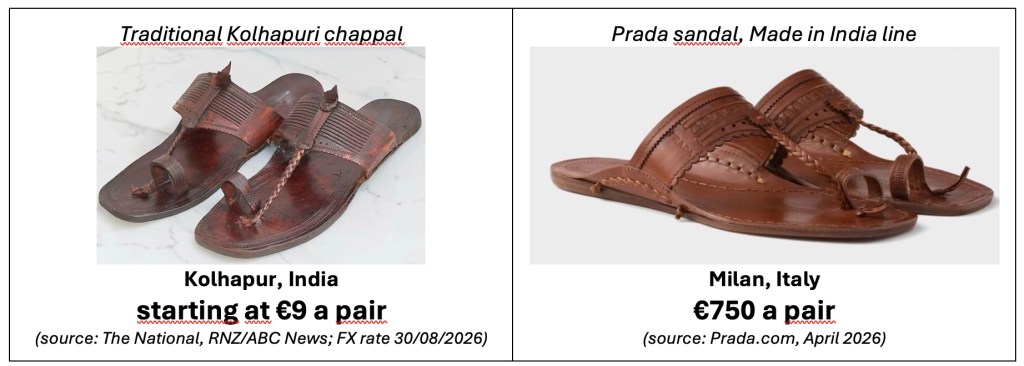
Look at the two photos. Same woven strap. Same thong sandal that Kolhapur’s artisans have hand-stitched for generations. In Kolhapur, a simple pair: nine euros. Today, on Prada’s website, the same design, made by the same artisans after the deal: seven hundred and fifty. Same design. Same hands. Only one thing changes: the name stitched on top. And that name, alone, is worth the difference.
Let’s say this upfront, or the point gets lost: drawing on other eras and other cultures is not a sin. It’s fashion’s normal state, and always has been. Every collection that looks to the past, to the flea market or the vintage rack, to the artisan’s workshop, is looking for an idea there. The Prada case isn’t a question of inspiration. It’s a question of something else: an already-registered right that nobody checked before putting the product on the runway. And it happened, I think, for exactly that reason: because nobody checked. The two products, for that matter, aren’t just similar: they’re practically the same design. So much so that, as part of the deal, Prada chose to have them made in the original region, by the same artisans. That’s the best proof of how identical the starting point really was.
This isn’t a one-sided opinion. The big houses know it well, and cultivate enormous archives for exactly this reason: G-Star owns thirty-eight thousand historical garments, photographed and catalogued, that designers “learn from,” says its creative director, not copy from. In 1965, Yves Saint Laurent dressed his clients in gowns cut and sewn as if they were Mondrian paintings: nobody ever called it appropriation, they still call it the Mondrian collection today. Chanel’s most iconic jacket comes from the tweed the Duke of Westminster wore hunting on his Scottish estates in the 1920s: Coco Chanel fell for it, and turned it into a women’s piece. Drawing on another era, another wardrobe, another culture, is the very trade of fashion. That is not what should be judged.
The facts
June 2025. Prada sends sandals nearly identical to the traditional Kolhapuri chappal down the runway in Milan, in its men’s Spring/Summer 2026 collection. No origin declared. As if the design had been born in-house. The backlash is immediate: artisans from the region meet with Maharashtra authorities, the story bounces around the international press, Prada is forced to publicly acknowledge the Indian inspiration. On this much there is no doubt: it’s a true, well-documented fact, from first-tier sources.
Online, the case also circulated with the wrong numbers. There was talk of a twenty-five-times price gap between the original and the Prada sandal. That number isn’t false: it holds for a comparison with the most elaborate local craftsmanship, the kind that runs up to thirty euros. But for a simple pair, bought at the market, the ratio tops a hundred times.
The real problem
But I don’t want to lose sight of the real point. The Kolhapuri chappal has a Geographical Indication registered since 2009, valid until 2029, owned by two bodies representing the artisan community: LIDCOM and LIDKAR. It isn’t a free-for-all design anyone can draw on. It has a recognized legal owner, exactly as a registered trademark protects a maison’s logo. And yet no authorization appears to have been sought before the runway show. No royalty appears to have been negotiated before the deal. The partnership with the Indian artisans came after the backlash, not before. Asking permission first costs a negotiation. Saying sorry after, once the reputational damage is done, costs less: and as long as the math works that way, nobody will change it on their own.
Let’s look at the price, then, because that’s where you see the distance between the product and the brand. Today, on Prada’s site: seven hundred and fifty euros. In India, the same design, made by the same hands: seven to nine euros for a simple pair, up to thirty for a more refined one. Same woven strap. Same craftsmanship. An origin Prada itself now acknowledges. In between, a multiplier that runs from twenty-five to a hundred times. This isn’t marketing. It’s a snapshot. It says exactly what the name stitched on top is worth, on its own. And there isn’t even a reinvention to justify it: it’s the same design, without a single new idea. A price this steep might be defensible when there’s added creativity behind it. On a product with no creativity, one that replicates an existing design almost exactly, it isn’t justified in any way. As a valuation of the brand, that’s not bad at all. As a measure of the distance between a product and its price, it says more than any analysis.
The problem isn’t that a major maison drew on a design from another culture. That’s fashion’s normal state, always has been, even for the world’s most prestigious maisons. The problem is that it did so on a design already protected by law. Without permission. Reselling it at a multiplier of twenty-five to a hundred times. Keeping almost all of that value, while whoever created it stayed on the margins, until public backlash made negotiating cheaper than ignoring. It wasn’t just a missing credit line. It was a missing payment. And that, as I see it, is the real betrayal: not so much the forgotten caption. The bill that was never paid.
It’s not an isolated case
Prada isn’t the first. It won’t be the last. Drawing on local craftsmanship, or a flea market on the other side of the world, is common practice in luxury, often with the best of intentions. That’s never the problem. The problem starts where recognition is missing, or payment to whoever created the design first.
In 2015 Isabel Marant sold a blouse nearly identical to the huipil of the Mixe community of Tlahuitoltepec, Mexico, for 290 dollars: six times the average price of an original huipil. In 2019 Mexico’s Ministry of Culture publicly accused Carolina Herrera of using, without credit, Tenango de Doria embroidery in a resort collection. In both cases, no compensation was ever made public.
The broadest case involves the Maasai people: the name and the shuka check pattern used, according to the Maasai Intellectual Property Initiative, by more than ten thousand companies, Louis Vuitton included. Six companies alone are estimated to have made over a hundred million dollars a year using that name. Until recently, the Maasai community had received nothing.
The difference, every time, comes down to the same thing: a registered right. In 2012 the Navajo Nation sued Urban Outfitters over the use of the Navajo name: it held registered trademarks, and in 2016 it secured a licensing deal. In 2018 Gucci sold a turban nearly identical to a Sikh one for 790 dollars: the community protested, but a religious symbol can’t be registered, and no deal ever came. Where the right exists, sooner or later, there’s a negotiation. Where it doesn’t, all that’s left is publicity.
Sources
New York Times, nytimes.com/2025/06/30/world/asia/india-prada-sandal.html
Times of India, timesofindia.indiatimes.com — “The Prada paradox”, artisans-Fadnavis meeting
Reuters, reuters.com/world/india — Prada acknowledges Indian inspiration (28/06/2025)
Hindustan Times, hindustantimes.com — Prada team’s visit to the artisans (July 2025)
Outlook Business, outlookbusiness.com — agreements with the artisan bodies (December 2025)
Prada Group, pradagroup.com/ww/en/pradasphere/special-projects/2026/made-in-india-kolhapuri.html (27/04/2026)
Economic Times, economictimes.indiatimes.com, articleshow/122072408.cms
The Indian Eye, theindianeye.com (28/04/2026)
ThePrint, theprint.in — price and launch timeline of the Made in India line
Brut India, brut.media/in — rupee price of the Made in India line
Kearney, “India: the next luxury hotspot?”, kearney.com — Indian luxury market, $7.74 billion (2023)
RNZ / ABC News, rnz.co.nz — photos and prices of the two products side by side
SCC Online, scconline.com — dismissal of the Bombay High Court petition (July 2025)
The National, thenationalnews.com — market prices of a handmade Kolhapuri chappal (June 2025)
Dhaga, idhaga.com — comparison between Prada’s price and the artisans’ price
Remezcla, remezcla.com — Isabel Marant and the Mixe community of Tlahuitoltepec (2015)
NPR, npr.org — Carolina Herrera and Mexican indigenous textiles (2019)
The Fashion Law, thefashionlaw.com — the Maasai case and use of the shuka name/pattern
Refinery29, refinery29.com — Navajo Nation / Urban Outfitters agreement (2016)
Fashionista, fashionista.com — fashion houses’ historical archives, G-Star Raw example (2018)
Musée Yves Saint Laurent Paris, museeyslparis.com — the Mondrian collection (1965)
The Scotsman, scotsman.com — the Scottish origins of the Chanel jacket
Today.com / NBC — the Gucci Indy Full Turban case (2018)
WWD, wwd.com — “Gucci Accused of Cultural Appropriation Over ‘Indy Turban’”


Leave a Reply