Scandicci, on the edge of Florence, is not one luxury. It is a mountain of luxuries, piled one on top of another. At the top are the big names, with large factories and hundreds of people: Gucci, Richemont, Dior. In the middle are workshops that can do things very few in the world can do. Lower down come subcontractors of subcontractors, where conditions get worse at every step. On the bag in the shop window there is one name. Underneath there are many, and they are not all worth the same.
A word of preamble. I am talking about one specific thing here: luxury made of products, of know-how, of carefully chosen materials and of hands that know what they are doing. Not the luxury that exists only because it is told. Luxury without a brand does not mean luxury without a name. It means luxury that exists before and beyond the label: in workshops, in the subcontracting laboratories that work for others and sign nothing.
How much does this world weigh? According to IRPET, in Scandicci 8,145 people work in leather goods, more than six in ten of those employed in local industry. Across Tuscany the figure is 31,593. Forget the shop window on Via Tornabuoni: here luxury is the trade of the people next door.
Then there is the question everyone asks, the one about money. In the questionnaire I am running among people who work in luxury, with over two hundred valid responses, a manufacturer who has worked for several large leather goods houses describes a bag sold at almost twenty times its production cost. It is one testimony, not proof. But that is not the interesting part. The interesting part is what happens to the people who make that bag, and often there is a family behind them.
Why do families matter so much in this world? Danny Miller and Isabelle Le Breton-Miller studied the family businesses that last and found four words that all begin with C. Command: deciding without answering to the markets every three months. Continuity: the will to endure. Community: people who stay. Connection: long relationships with clients and suppliers. A fund buys, optimises, resells and says goodbye. A family with its surname on the door cannot say goodbye to anyone.
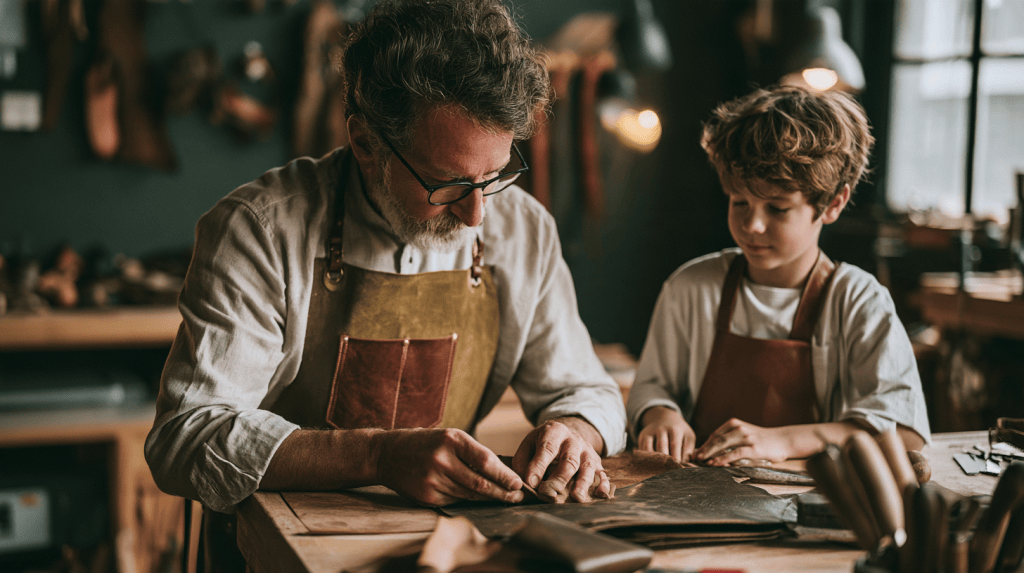
What do these families pass on? Not a technique: that can be found in schools and in machines. They pass on a way of looking and a way of doing, which is transmitted through closeness. Imagine a boy growing up in a workshop. He watches his father reject a piece that looked perfect to him. He hears ‘this is not right’, with no explanation, and one day he finds he can see it too. Richard Sennett defines craftsmanship as the desire to do a job well for its own sake. In these families the beautiful and the well made are not two separate lessons. They are the same lesson, learned together, in the same place.
My questionnaire sets out to understand what remains of this culture inside companies, with all due caution: these are anonymous perceptions from people in the sector, on a non-random sample. They help us understand, not prove. A retail manager who has worked for a historic Italian cashmere house and for a major fashion maison describes two worlds. The first cares about quality from the fibres to the sale, out of attachment to its own heritage. The second sells mostly the name, and the gap widened after the founder’s death. One case does not make a rule. But quality seems to last where there is a founding guide and a culture that outlives them, more than where there is only the reputation of the brand.
So much for the good part. Now for the real one. Being a good subcontractor today is a trade full of traps, and almost none of them concern the quality of the work.
The first is the single client. The owner of a workshop told me that 90% of his work comes from one client. If that client changes supplier or cuts volumes, the workshop feels it at once. A big client is an honour. A single client is a risk.
The second is the price, which you do not set. Il Sole 24 Ore estimated margins of 7 to 8% for small producers, against 25 to 30% for luxury houses. With margins like that you cannot invest in machinery, digital tools or training. A craftsman in the Valdarno took out a loan to buy the machines the house required and now struggles to pay the instalments. Someone always pays for quality. Usually not the person who sells it.
The third is the bitterest: those who comply with the rules can lose the order. A trade unionist in Prato told me about a supplier who lost his contracts after regularising all his employees, and the work went to a company running twelve-hour shifts. It is one side’s version, but it explains the mechanism. If the cheapest always wins, the person who plays fair pays the bill.
The fourth is the missing hands. In 2020 half of the jobs in leather goods were hard to fill, in 71% of cases because of inadequate preparation. The big houses have in-house academies. A workshop of ten people, with those margins, cannot afford one. A trade takes years to learn. It can be lost in months.
The fifth is the weight of the numbers. According to Assopellettieri, in the first nine months of 2024 the leather goods sector lost about 1,300 jobs and more than a hundred companies closed. And a craftsman in the Valdarno points out that wage support for artisan firms lasts twelve weeks, far less than for industry.
The sixth appears in no balance sheet: invisibility. A workshop that signs nothing accumulates no reputation. The reputation is collected by whoever tells the story of the product, not by whoever makes it. The good subcontractor does not have a problem of hands. He has a problem of power.
Why is invisibility so hard to solve? Because it is a problem of information, before it is one of power. Economists distinguish three kinds of quality: those you can see before buying, those you discover by using the product, and those the customer cannot verify even afterwards, the credence attributes. How a seam is made, how a sole is made, where a stone comes from. That is exactly where the good workshop makes the difference. And there the customer can neither reward nor punish. They can only believe. Making them believe is the job of whoever has the money for the signals: the shop on the right street, the advertising campaign, the brand. George Akerlof showed it as early as 1970: if customers cannot tell quality apart, they pay the average price, and whoever offers quality must lower it or leave the market. The price premium thus goes to those who communicate, not to those who make.
The questionnaire also offers the view of those who work inside the luxury houses, and it is the part that struck me most. People who work with the product describe the decline in quality, when there is one, almost always as a choice and not as a mistake. The most cited cause is pressure on margins, often linked to the arrival of finance. But between the lines there is another story, less often told: the maisons are losing skills.
How? In several ways. Technical figures are replaced by more generalist profiles. Quality controls, once piece by piece, become sample checks. A goldsmith describes a bracelet that was once worked entirely by hand and is now partly entrusted to numerically controlled machines and laser engraving, with the artisans becoming the buffer on which cost reductions are unloaded. A creative director in high jewellery describes an iconic ring whose diamond pavé was lightened over the years with small stones, to cut costs, in a decision taken by the very committee that should guarantee its consistency. A marketing manager in eyewear says that many houses sacrifice part of their quality to fund direct store networks and advertising campaigns.
The point is what follows from this. A maison that has lost its technical culture can no longer judge a good supplier, except by price. And so the good workshop, which costs more because it works better, loses out to the one that costs less. It is the mechanism I described earlier. The questionnaire responses do not put it in these terms: it is my reading, but it seems to me the most natural one.
And the customer? In the responses, the customer is almost always the last to notice, when they notice at all. In a minority of cases nobody notices, which is perhaps the most disturbing finding: a betrayal that goes unobserved. Sectors differ: the creative director notes that jewellery keeps an attention to materials and workmanship that fashion, even at the highest levels, shows less of.
If technical know-how is thinning out inside the companies, what remains lives in the workshops. And the workshops, as we have seen, have no power to defend it.
And so? What does all this mean? Three messages.
The first is for the luxury houses. Know-how does not live in your offices. You can pay it fairly, respect it, buy it. But there is one thing you cannot buy: the knowledge that walks out of the door with the family. If the family leaves, you are left with the building.
The second is for those who work as subcontractors. Look for a second client before the first one looks for a second supplier. Put your name on the product where you can. And make legible what today is only a declaration: certification by a third party, traceability. Knowing how to do one thing superbly is not enough if everything depends on one person’s phone call.
The third is for those who buy. Next time you spend three thousand euros on a bag, ask: who made it? If the shop assistant answers with a poetic tale about the history of the house, you already have your answer. If they can tell you the town, the workshop and how long it takes, you are looking at a rarity. Something is moving: in my questionnaire, a salesperson at an independent watchmaking manufacture describes clients, mostly young, who ask about the architecture of the movement and the finishing before they ask about the price. Ten years ago they trusted the name. A high price says nothing about who is at the end of the chain.
Real luxury does not live where things are signed. It lives where things are made. And whoever knows how to make them almost always has a surname, not a logo.
A sign can be bought. A craft is inherited, or it is lost.


Leave a Reply