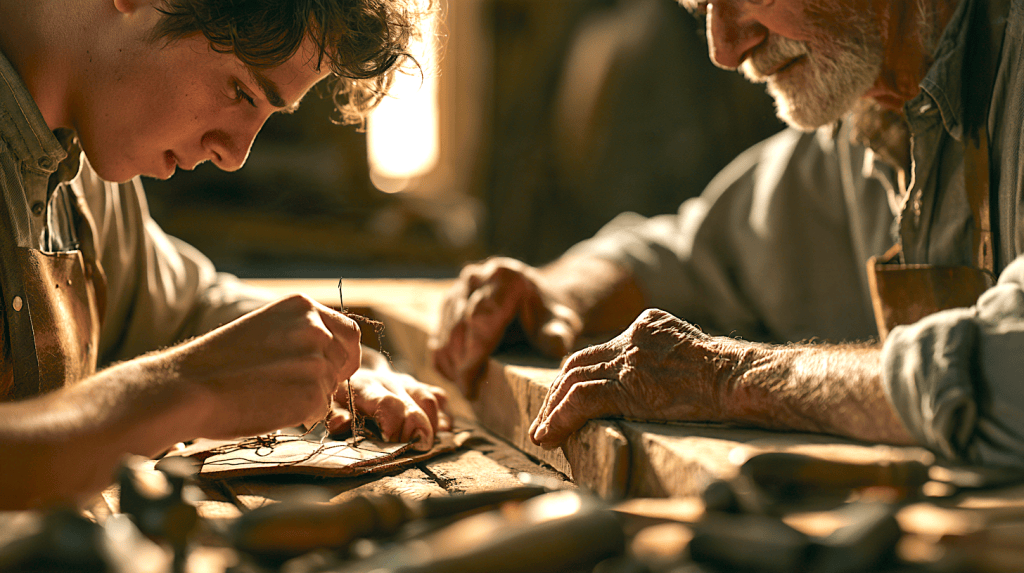
What is craftsmanship? Italy’s Treccani encyclopaedia describes it as the work of someone who makes things by hand, perhaps with a few helpers: everyday objects that may have “cultural value” and “aesthetic qualities”. Useful, not just beautiful.
We have turned it into a box to tick in labour regulations: a maximum headcount, a register, a collective contract. We stopped asking what a craftsman knows how to do.
Yet that is where real luxury is born: well-made products, from hands that know what they are doing. Not the kind that exists only because it is told.
And where is that craft learned? Almost always in a family.
At the top, LVMH, Kering, Richemont, Hermès and Chanel all have a family at the helm. But I don’t want to talk about them. I want to talk about the thousands of Italian SMEs: the workshop with no sign over the door, the leather goods maker working for others, the bench where a goldsmith has been setting stones for thirty years.
A business family hands down two things. Its wealth, and a craft that no will can bequeath. You learn it by standing alongside, watching, getting it wrong, long before any school.
But the family gives luxury something more.
Time, first of all. A family thinks in generations, not quarters. It can invest in an apprentice today and reap the benefits years later. Whoever has to sell the business on in a few years is tempted to do the opposite: cut where the customer can’t see. Margins rise at once, the damage comes later.
The name. When your surname is on the door, a poor product is not a process failure. It is a family disgrace. A study of 19 Italian family firms in luxury confirms it: family reputation pushes towards quality.
Freedom to decide. No market to win over every three months. You can keep a slow process, or say no to a shortcut that is good for the balance sheet and bad for the product.
People who stay. Craftsmen who spend a lifetime in the firm because they feel at home there. And the know-how lives in their hands.
Trust. Suppliers who last for decades, because people know each other and a handshake is enough.
Roots. The family lives in the district and knows its workshops. Moving to wherever costs less would mean betraying its own history.
And one thing nobody puts on the list: there is no way out. A fund buys, optimises, sells and waves goodbye. A family with its name on the door can’t wave goodbye to anyone.
These small firms hold a culture: know-how and a taste for beauty. Not just technical skills. If they are lost, it is not a supplier that disappears. It is a piece of us.
It is not all roses. Every strength can turn into a weakness: the long view into slowness, freedom into inertia, roots into insularity. Succession and openness to outsiders remain the most serious weak points, and young people willing to learn these trades are scarce.
I leave the question to you: if these families ceased to exist, who would safeguard the know-how?


Leave a Reply