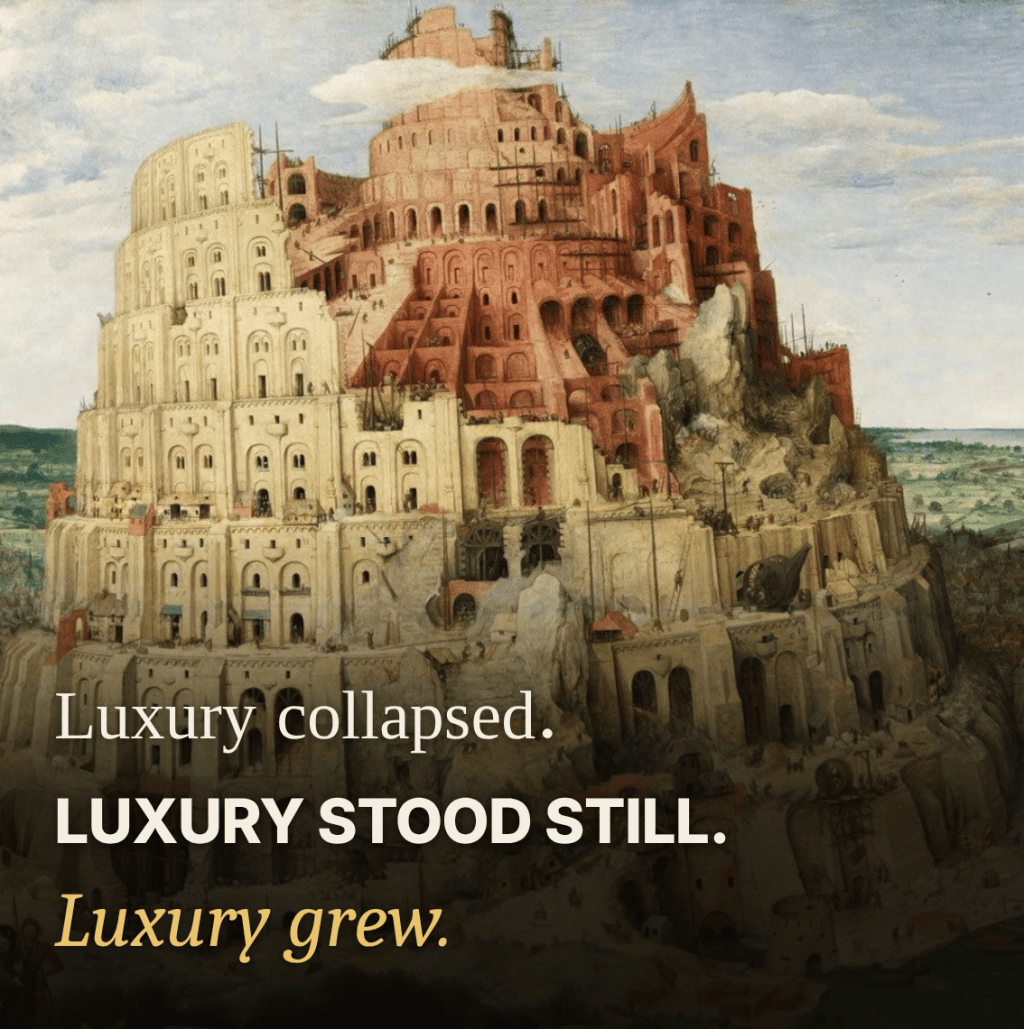
In 2025 luxury collapsed. In 2025 luxury stood still. In 2025 luxury grew by almost 9%.
All three sentences are true, and each one is about a different fact. Gucci lost 19% on a like for like basis. The total luxury market, according to Bain, moved between minus 1 and plus 1% at constant exchange rates. Hermès grew 8.9% at constant exchange rates. Each of them can sit under a headline that starts with “Luxury”.
In the Bible the tower of Babel does not stop because the bricks run out. It stops because the workers, who until the day before spoke the same language, stop understanding each other.
Luxury in 2025 is a building site like that. Same market, same words, different languages. Whoever says crisis is talking about Gucci. Whoever says boom is talking about Hermès. Whoever says stagnation is talking about the average. They are all right and they do not understand each other. Meanwhile nobody stops to ask which language they are speaking.
Before asking whether luxury is in crisis, let us ask what we are talking about. I start from the numbers. They all come from one source, so for one paragraph at least we speak the same language: the study by Bain and Altagamma, the association of Italian luxury companies, published in November 2025. These are estimates, at current exchange rates unless I say otherwise.
How big is luxury, and how is it doing
Luxury as a whole, meaning the nine segments Bain counts, from cars to hospitality, is worth about 1,440 billion euros in 2025. In euros it is down between 1 and 3% on 2024. Inside it, luxury cars are worth 545 billion, down 6%, and luxury hospitality 251 billion, up 3%. All these figures are at current exchange rates: converted into euros at each year’s rates.
There is a second way to measure: constant exchange rates. Sales are recalculated as if currencies had not moved. It measures demand, not currency swings. Bain publishes it only for the totals, and there luxury is flat, between minus 1 and plus 1%. The gap of about two points between the two measures is the effect of currencies.
Personal luxury goods, what we picture when we say luxury: fashion, bags, jewellery, perfume, are worth 358 billion, against 364 in 2024. Down 2% at current rates, stable at constant rates. They are about a quarter of total luxury.
What is inside, and what is going wrong
Personal luxury has seven sectors. Here is how they did in 2025, according to Bain. For sectors only changes at current rates exist, so I use those.
| Sector | Value (billion euro) | Change 2025 |
| Beauty | about 78 | 0 to plus 2% |
| Clothing | about 75 | minus 1 to plus 1% |
| Leather goods | about 74 | minus 5 to minus 7% |
| Watches | about 52 | minus 1 to plus 1% |
| Jewellery | about 32 | plus 4 to plus 6% |
| Footwear | about 24 | minus 5 to minus 7% |
| Eyewear | about 17 | plus 2 to plus 4% |
Retail values, changes at current rates, Bain estimates given in ranges. They are rounded estimates: the seven values add up to 352, not 358. In the pages I read, the gap is not explained.
According to Bain, two sectors out of seven are doing badly: leather goods and footwear. Together they are worth about 98 billion: 27% of personal luxury and 7% of total luxury. In one year they lost between 5 and 7%, which, by my own calculation on Bain’s ranges, is between 5 and 7.5 billion current euros. Jewellery and eyewear are growing. Beauty, clothing and watches are flat, within Bain’s ranges.
Does that mean every company selling leather goods and footwear is doing badly? Company numbers cannot say. The same groups also sell clothing, jewellery and perfume, and their releases do not split the categories. Inside a group, leather goods can fall while other categories grow a lot, and the total hides it. What we do see is that, in the same market, companies go in opposite directions. In 2025 Hermès grew 8.9% at constant rates, Gucci lost 19% like for like. Miu Miu sold 35% more through its shops and website, at constant rates; Prada lost 1%. LVMH, across all its sectors, fell 1% on an organic basis, which means same perimeter and constant rates.
Some do very well. Richemont closes its financial year on 31 March, so its period does not match the calendar year. In the year to 31 March 2026 sales rose 11% at constant rates and 5% at actual rates: six points between the two measures. Inside the group the jewellery maisons, about three quarters of sales, grew 14%, specialist watchmakers 1%, and “other”, which includes fashion and accessories, 3% but with an operating loss of 96 million euros. One group, three directions.
So “luxury is in crisis” does not describe a general fall. It describes a flat market, in which some sectors fall and others grow. And even in the growing sectors some companies do badly.
A note on words. In the Bain and Altagamma press releases of November 2025 and June 2026 the market is described as resilient, stabilising, at a crossroads, in structural reset. The word “crisis” on its own does not appear. I find it elsewhere: in several newspaper headlines, and in the language of those who represent the small businesses of the supply chain, such as the craft association CNA in Florence for leather goods. Different sources, different purposes. Readers should know who is speaking.
And 2026? Forecasts, not results
All of this is 2025, which is closed. 2026 is not, and for this year only forecasts exist. A forecast is a hypothesis with a probability, not a result.
Same source. The Bain and Altagamma update is dated 25 June 2026, with data to 19 June. It says this.
- The first quarter of 2026 is the latest figure: between minus 5 and minus 3% at current rates for personal luxury goods, against a year earlier.
- For the full year the base scenario, with about 70% probability, has personal goods between 365 and 373 billion, which is plus 2 to plus 4% at constant rates. The favourable scenario, plus 4 to plus 6%, has about 20%. The unfavourable one, zero to plus 2%, about 10%. For total luxury the forecast is zero to plus 2% at constant rates.
Two warnings. The first quarter is at current rates and the forecast is at constant rates: the two numbers are not homogeneous. And a forecast says where the market is going, not who is carrying it.
And the companies? The first nine months of 2026 are partial results, from different sources and measures: do not compare them with Bain or with 2025. But the direction shows. Jewellery goes up: LVMH plus 8% organic, Kering plus 17% like for like, Richemont plus 24% at constant rates from April to June. Leather goods go down: LVMH fashion and leather goods minus 2% organic, Gucci minus 5%, with the exception of Hermès, plus 10.2% in leather goods and saddlery.
The lack of clarity: three statements that are missing
Everyone argues about whether the patient is well or ill. Nobody asks whether we are looking at the same patient. The headline says “luxury”. The numbers speak of different sectors, of companies going in opposite directions, of measures that cannot be compared. The problem is not that headline and numbers drift apart. The problem is that nobody declares what they call luxury, how they measure it and who they are talking about. Without these three statements a reader can verify nothing.
I call them this way. The measure: what is counted and how. The object: what is called luxury and who belongs to it. The unit: who we are talking about, the market, a sector, a company, or a person who buys. When one statement is missing, the discussion no longer knows what it is discussing. The concrete consequences are two.
- Whoever decides without internal data looks at the average: the investor, the bank, the supplier, the small company that has to plan its orders. The accounts say “fashion and leather goods” and none of them can ask what is inside. Whoever runs a big house has finer numbers, by channel, country and category, and does not publish them all.
- The customer has no way to check three simple things: what am I buying, why does it cost so much, how long will it last. If they cannot answer, they rely on the name. The brand is a shortcut that works as long as it holds.
This is my thesis: before asking why luxury is in crisis, we have to clarify what is in crisis. The lack of clarity is one of the causes, not the only one, and I present it as a hypothesis to be tested.
From the missing statements come four disorders: the measures, the definition, the sum and the people. In this piece, the first two.
First disorder: the numbers speak different languages
The figures for LVMH, Hermès, Gucci and Miu Miu above do not measure the same thing. For LVMH the figure is organic: the effect of currencies and of acquisitions and disposals is removed, and the same perimeter is compared with the same currencies. In euros actually collected the group lost 5%, not 1%. For Hermès the figure is at constant rates: sales are recalculated as if currencies had not moved. At actual rates growth is 5.5%, not 8.9%. Gucci is “comparable”, the word Kering uses for the same comparison, same perimeter and constant rates. The reported figure is minus 22%, not minus 19%.
Between one measure and another there are three to four points, six in Richemont’s case. None is wrong. But lining them up without saying so is like comparing apples and pears and then being surprised by the result.
Second disorder: the definition
When we say “luxury”, what are we talking about?
Take the “fashion and leather goods” line of LVMH. Inside are maisons such as Louis Vuitton, Dior, Celine, Loewe, Fendi, Loro Piana. In the same list there are also Berluti, Givenchy, Kenzo, Pucci, Rimowa, which makes suitcases, and Vuarnet, which makes sunglasses. And inside each of them there are things that look nothing alike: the bag you wait years for and the one you buy in an afternoon, the tailored suit and the T shirt with a logo, the leather that lasts a lifetime and the seasonal trainer. One label, one total.
Who decided that all this is luxury? Nobody. There is no authority, no register, no shared definition. There are three implicit criteria, and none stands on its own.
The first is belonging: if a company is part of a luxury group, or the study that measures the market decides to count it, everything it sells counts as luxury.
The second is the accounts: “fashion and leather goods” is an accounting line. It says what an object is made of, not what it is worth. The third is price: it costs a lot, so it is luxury. But price is exactly what we should explain, not use as proof.
The consequence is simple. A leather bag you wait years for and a leather bag you find in every airport sit in the same category. The category answers the question “what is it?”, not the question “how much is it worth, and why?”. We use a definition of type to answer a question of level.
On one point I am not joking. Those who work upstream, in the workshops and small companies that produce for third parties, do not read averages. They read orders. We will talk about them, with numbers, in a dedicated piece.
The rule I take away is double: never a number without saying what it adds up, never a label without saying what it contains. If it does not say so, it does not describe a sector, it describes an average. And nobody has ever bought an average.
Next time, the other two disorders: the sum and the people, that is, who pays the bill. In the third piece, the reason for the confusion. Tomorrow, Friday 13 November, Richemont publishes its half year results: I will come back to them.
In the report you are reading, or in the sector you follow, which word is hiding more than it says?
Read this piece in Italian: https://antoniocatalani.com/2026/11/09/il-lusso-e-in-crisi-di-che-cosa-stiamo-parlando/.


Leave a Reply